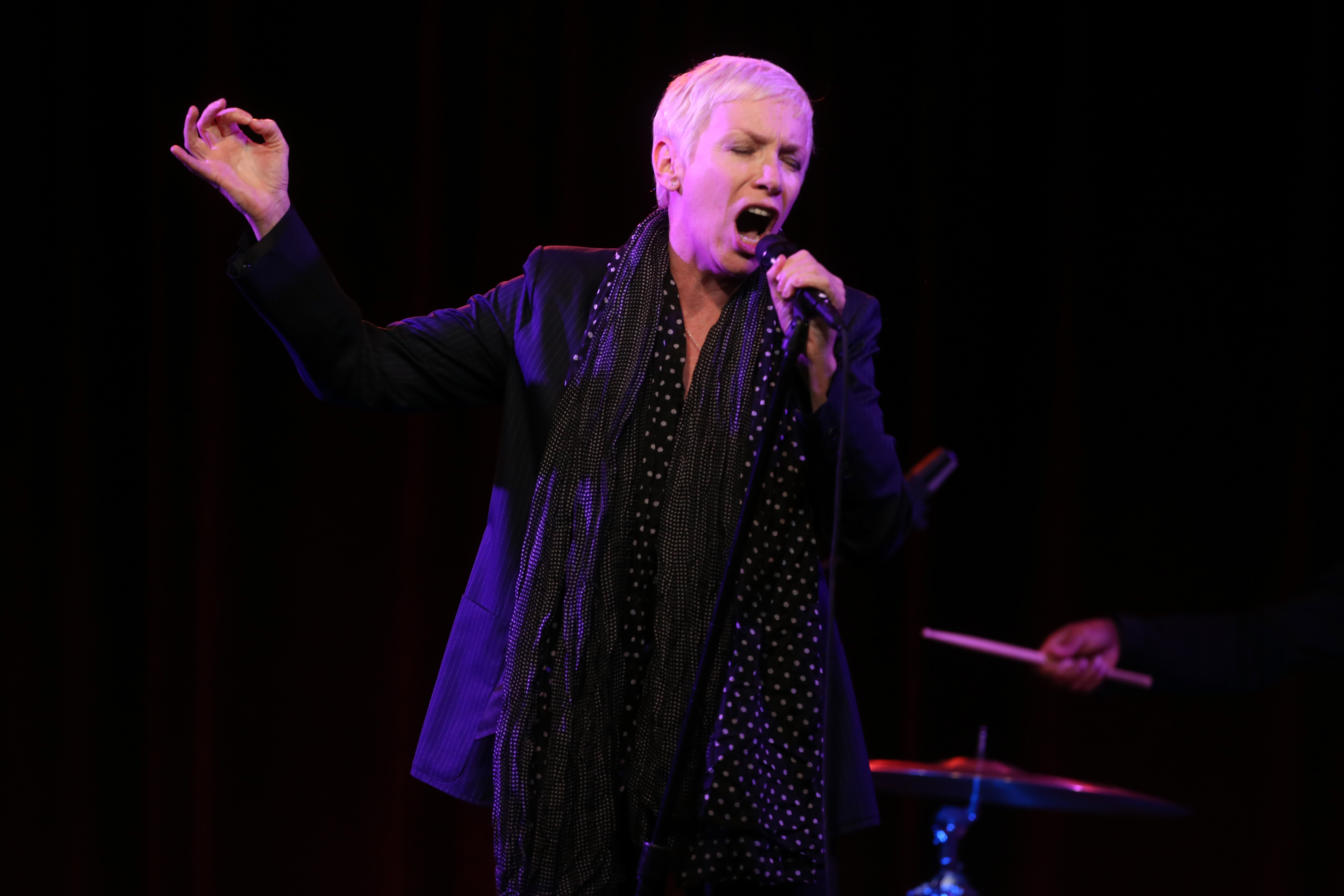
Annie Lennox during the ‘Great Performances Annie Lennox: Nostalgia in Concert’ performance and panel discussion at the PBS Network portion of the Television Critics Association press tour, January 19, 2015 in Pasadena (Getty)
Annie Lennox was criticized online last fall for not mentioning on Tavis Smiley’s show the connection between the lyrics of “Strange Fruit” and lynching.
On Monday night, at the Television Critics Association Winter Tour in Pasadena, Calif., where Lennox made an appearance to promote “Great Performances: Annie Lennox ‘Nostalgia’ in Concert” on PBS, she had a chance to address the criticisms that came following her appearance last fall on “Tavis Smiley.”
“I was talking to Tavis. We were having a conversation, and I was very engaged with him,” Annie told reporters at the PBS portion of the TCAs. “And I guess I was thinking at the time, he knows what I’m talking about. I wasn’t thinking about the other picture. I was thinking more about the undercurrent of violence that is inherent in the entire human race. So I didn’t refer to the lynchings in our interview because I already assumed, obviously, that Tavis, being an incredibly intelligent and knowledgeable man, especially of African origin, would know what I was talking about. And then somebody took issue with that, and the whole thing exploded, and it was so painful for me.”
PHOTOS: Star Sightings: Week Of January 19, 2015
Lennox said being called out for not mentioning the lynchings was hurtful (she told Tavis it was a “protest song,” written “before the Civil Rights movement got on its feet”).
“It was so painful — I can’t even begin to tell you — because I’m the last person that would disrespect that history. And then, one person put on a nasty blog this, and the whole thing blew out of context, and I couldn’t come back [to Tavis’ show], because if I did that, it would all get blown up again, so I had to just be quiet, and this is a phenomena of our times that we live in with Twitter and social media and everybody commenting is that it’s very tricky,” she said.
WATCH: The Eurythmics’ Annie Lennox & Dave Stewart Reunite For The Beatles Tribute Concert
Lennox said the criticism surprised her.
“The last thing I would have thought was that people would say, ‘Oh, she didn’t mention the lynchings in the South,'” she said.
“I’m a person who really, really cares about social injustice, and racism is so vile to me and it disturbs me,” she continued.
The singer also offered an apology to anyone who took offense to what she didn’t say.
PHOTOS: Music’s Biggest Rock Stars Through The Years
“If I offended anyone, anyone, about not mentioning lynchings, I wholeheartedly apologize,” she said. “But it was never intended. And I was hurt by this nasty blog. It was an opportunistic swipe at me, to be quite frank.”
Lennox is set to take part in PBS’ Great Performances, “Annie Lennox, ‘Nostalgia,’ Live In Concert,” airing in April on the network. Earlier in the panel she mentioned covering jazz standards for the album and the special, and the influence of black music on her career.
“There are 12 tracks on the album, and every single one I felt had to be there. And there’s a journey right from the very start of ‘Nostalgia’ taking you through to a mood, the darkest mood which, if you had a vinyl copy, would be the last track, track No. 6, which is ‘Strange Fruit,’ which is so, so, so dark. Then, you flip it on the other side, and you come into a sort of sentimental, beautiful, romantic kind of aspect of it all, and I think it kind of beautifully summed up the sense of what nostalgia is because nostalgia is a mix — not my record, but nostalgia of itself has to be a mix of everything — the light, the shade, the good, the bad and the ugly, you know,” she said. “And some aspects of that are — I discovered — in those songs. The whole fact that the Civil Rights movement hadn’t even begun at that point is very, very telling for me as an artist, and to think that I have been so influenced by African American music that goes way back to African roots is so — it’s so moving and so powerful. I mean, I would like to see a world that had no color, no skin color. I’d love to see that world that was completely irrelevant what color of skin you had, because I feel that music is the connector you see. … I always say music is the great healer, is the powerful connecting force, and I really believe that.”
— Jolie Lash
Copyright © 2025 by NBC Universal, Inc. All Rights Reserved.
This material may not be republished, broadcast, rewritten or redistributed.